Learning Outcomes
By the end of this lesson, students will be able to:
i. Define and explain the concept of a saturated solution, recognizing that it contains the maximum amount of solute that can be dissolved in a given solvent at a specific temperature.
ii. Differentiate between saturated and unsaturated solutions, understanding that unsaturated solutions can dissolve more solute, while saturated solutions have reached their solubility limit.
iii. Explain the concept of a supersaturated solution, recognizing that it is an unstable state where more solute is dissolved than is normally possible at a given temperature.
iv. Describe the conditions that lead to the formation of saturated, unsaturated, and supersaturated solutions.
v. Apply the concepts of saturated, unsaturated, and supersaturated solutions to explain real-world phenomena, such as sugar dissolving in water or crystallization from solutions.
Introduction
The world of solutions is not a static one; it is a dynamic realm where the amount of solute dissolved in a solvent can vary. Understanding the different types of solutions, namely saturated, unsaturated, and supersaturated, is essential to comprehending the solubility limits and conditions under which each type forms.
i. Saturated Solutions: When the Limit is Reached
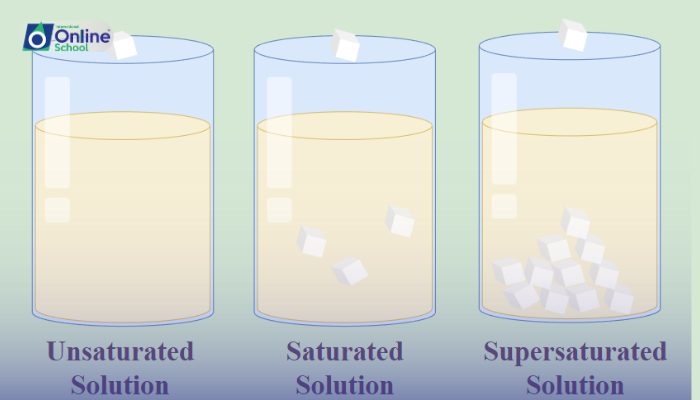
A saturated solution is one in which the maximum amount of solute has been dissolved in a given solvent at a specific temperature. At this point, the solution is "saturated," meaning it cannot dissolve any more solute. Any additional solute added will remain as a solid or a separate liquid phase.
ii. Unsaturated Solutions: Room for More
An unsaturated solution is one in which more solute can be dissolved in a given solvent at a specific temperature. This means that the solution has not yet reached its solubility limit, and additional solute can be added until the solution becomes saturated.
iii. Supersaturated Solutions: Pushing the Limits
A supersaturated solution is an unstable state in which more solute is dissolved in a solvent than is normally possible at a given temperature. This state is achieved by carefully controlling conditions, such as evaporation or rapid cooling, to prevent the excess solute from crystallizing out.
iv. Conditions that Influence Solution Saturation
The saturation of a solution depends on several factors:
Temperature: Solubility generally increases with increasing temperature. This means that a solution that is saturated at a lower temperature may become unsaturated at a higher temperature.
Nature of Solute and Solvent: The solubility of a solute depends on its chemical properties and the properties of the solvent. For example, ionic compounds tend to be more soluble in polar solvents like water, while nonpolar compounds are more soluble in nonpolar solvents like oil.
External Pressure: Increasing pressure can increase the solubility of gases in liquids. This is why carbonated beverages can contain more dissolved carbon dioxide under higher pressure.
v. Real-World Applications of Solution Saturation
The concepts of saturated, unsaturated, and supersaturated solutions have various applications:
Sugar in Water: Dissolving sugar in water is an example of an unsaturated solution, as more sugar can be added until the solution becomes saturated.
Crystallization from Solutions: The formation of rock candy, where sugar crystals grow from a supersaturated solution, is a practical example of this phenomenon.
Pharmaceutical Formulations: Supersaturated solutions can be used to deliver higher concentrations of drugs, improving their effectiveness.
Industrial Processes: Solubility principles are crucial in various industrial processes, such as purification, crystallization, and solvent extraction.
The concepts of saturated, unsaturated, and supersaturated solutions provide valuable insights into the behavior of solutions and their solubility limits. By understanding these concepts, we gain a deeper appreciation for the dynamic nature of solutions and their applications in various fields of science and technology.
